TSX-V: NEXM $

NASDAQ: NEXM $

Selkirk

LOCATION:
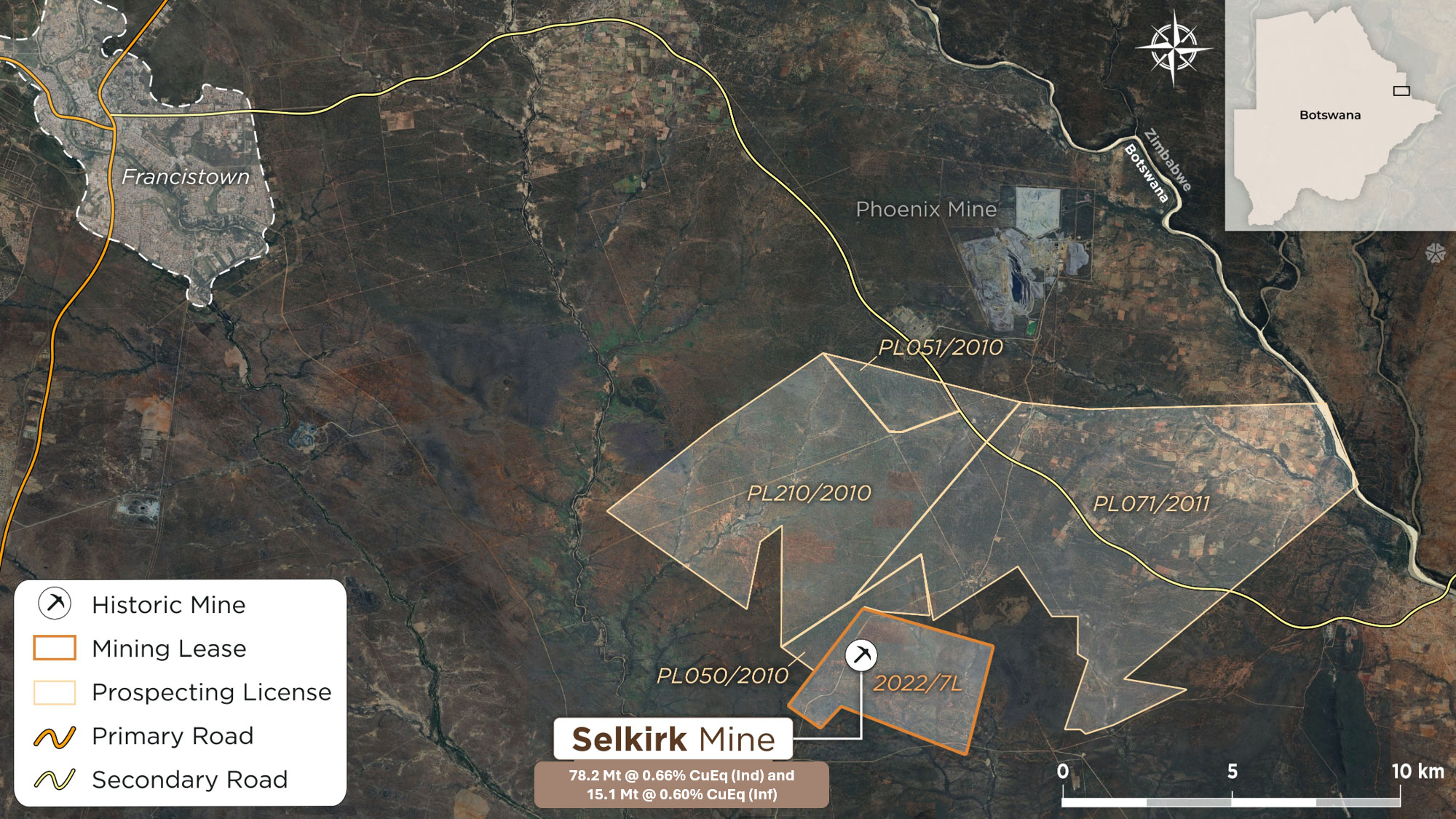
28 km southwest of the city of Francistown, Botswana
OWNERSHIP:
100%
DEPOSIT TYPE:
Intrusive magmatic sulphide deposit
Stage
Past producing
PRIMARY MINERALS:
Copper, Nickel, Cobalt, Platinum and Palladium (PGE)

Selkirk Resource Highlights

Mining licence spans ~14.6 km², with an additional 126.7 km² across four surrounding prospecting licences.
Historical production of ~1 Mt grading 1.6% Cu and 2.6% Ni (1989-2002).
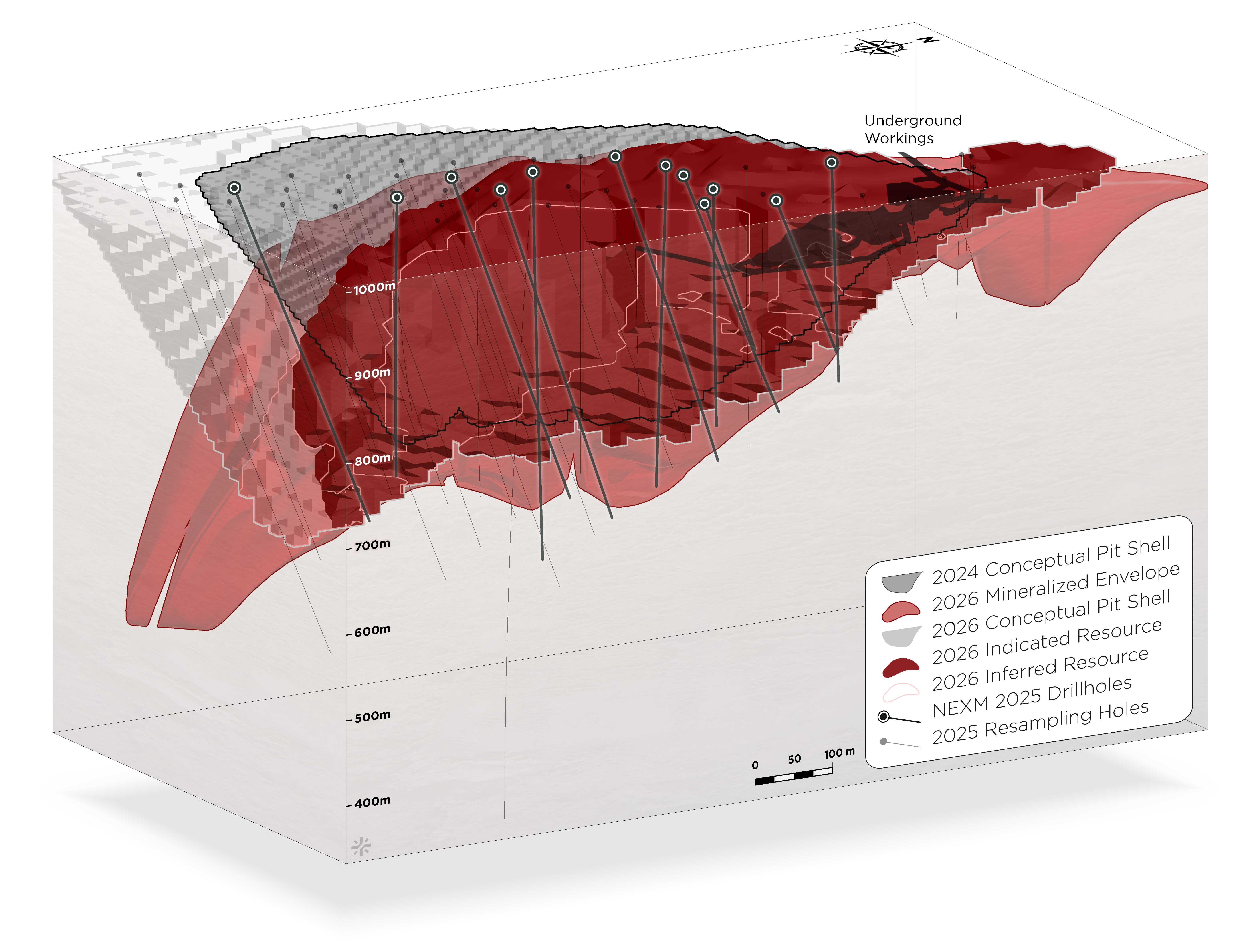
Shallow, laterally extensive mineralization supports open-pit development potential.
Current resources represent only a portion of the interpreted mineralized system, highlighting growth potential.
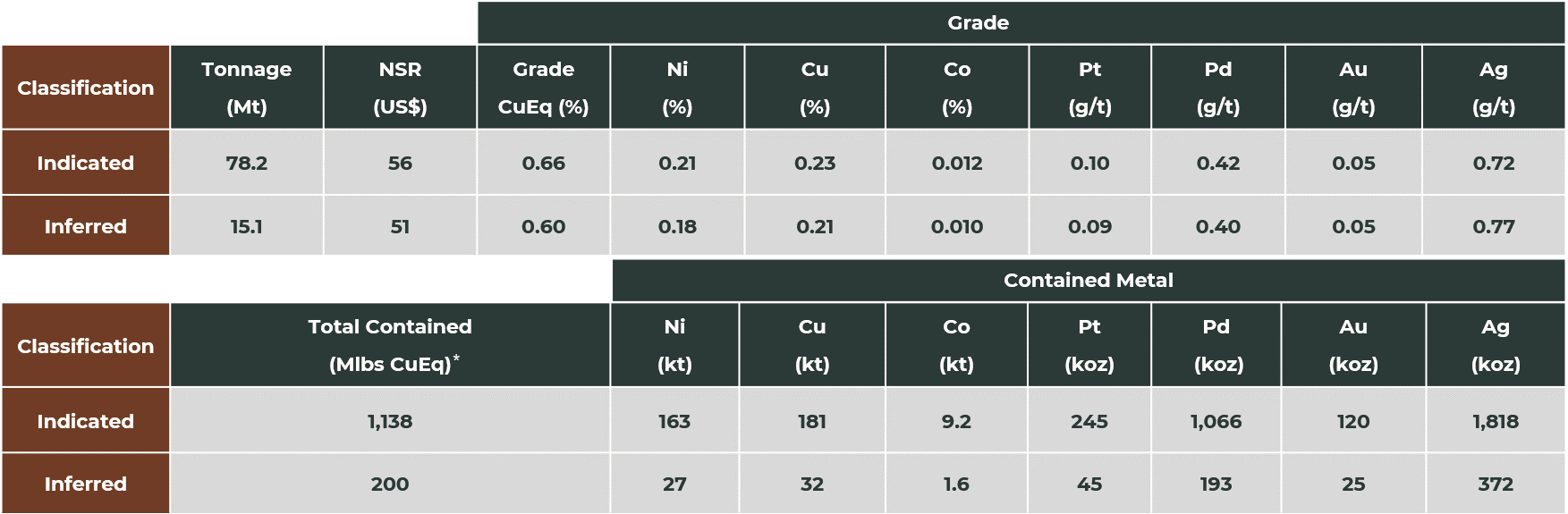
Inferred Mineral Resource Estimate of 44.2 Mt grading 0.81% CuEq.
*CuEq% calculated using the formula Cu% + Ni%*(55.605/53.913) + Pd g/t*(22.948/53.913) + Pt g/t*(14.891/53.913) using metal prices and recoveries listed below in Notes.
Notes:
  1. CIM (2014) definitions were followed for mineral resources.
  2. Mineral resources are estimated at a NSR cut-off value of $25/t.
  3. Mineral resources are estimated using long-term prices of US$10.50/lb Ni, US$4.75/lb Cu, US$1,450/oz Pt and US$1,500/oz Pd, and a US$: BWP exchange rate of 1.00:13.23.
  4. Mineral Resources are estimated using nickel, copper, palladium, and platinum recoveries of 60%, 70%, 59%, and 59%, respectively, derived from metallurgical studies which consider a conceptual two concentrate scenario.
  5. Bulk density has been estimated.
  6. Mineral resources are reported within an optimized pit shell.
  7. There are no mineral reserves.
  8. Mineral resources that are not mineral reserves do not have demonstrated economic viability.
  9. Totals may not add or multiply accurately due to rounding.

Growth Potential

Since acquisition, NexMetals has completed extensive data validation, core re-sampling and re-assaying programs, geological modelling, metallurgical testing, and exploration drilling to verify and enhance the historical database. This work culminated in the completion of the 2024 NI 43-101 Mineral Resource Estimate, outlining Inferred Mineral Resources of 44.2 Mt grading 0.24% Ni, 0.30% Cu, 0.55 g/t Pd, and 0.12 g/t Pt. Importantly, modern re-assaying programs captured significant palladium and platinum values that were not systematically incorporated by previous operators, highlighting the potential for further resource growth through additional PGE analysis.
 
The 2025 work programs, including a 12-hole drilling campaign, a 34-hole re-sampling program, and borehole electromagnetic (BHEM) surveys, have continued to confirm the scale and continuity of the mineralized system. Results include broad mineralized intercepts such as 231.0 m grading 1.09% CuEq and 180.8 m grading 1.31% CuEq, while also confirming high-grade footwall mineralization that could potentially represent additional exploration upside.
 
Metallurgical studies have successfully produced separate clean saleable copper and nickel concentrates, representing a major de-risking milestone for the project. Test work achieved copper recoveries of approximately 81% to a 30.2% Cu concentrate and nickel recoveries of approximately 54% to a 10.9% Ni concentrate, with final analytical results confirming that both concentrates meet commercial smelter specifications. These results support the potential for conventional concentrate production and further advance Selkirk toward an updated Mineral Resource Estimate.

Geology

The Selkirk deposit is an intrusive magmatic copper-nickel-platinum group element (Cu-Ni-PGE) sulphide deposit located within the Tati granite-greenstone belt of the Zimbabwe Craton in northeastern Botswana. Mineralization is hosted within the Selkirk metagabbro intrusion, which forms part of the Selkirk Formation and is associated with other magmatic Cu-Ni-PGE deposits in the district, including Phoenix and Tekwane. The Selkirk metagabbro has been dated at approximately 2.7 billion years old.

Two styles of mineralization occur at Selkirk: massive sulphides and disseminated sulphides. The historically mined massive sulphide mineralization occurs within the metagabbro intrusion and has largely been extracted, while a broad halo of matrix and disseminated sulphide mineralization surrounds and extends down plunge from the mined-out core. The disseminated mineralization averages 100 m to 150 m in thickness, extends for approximately 900 m from surface, and remains open at depth. The principal sulphide minerals are pentlandite, pyrrhotite, chalcopyrite, and pyrite, which host copper, nickel, platinum, and palladium mineralization.

NI 43-101 Summary

NexMetals Mining Corp. completed an NI 43-101 Mineral Resource Estimate (MRE), effective November 1, 2024, for the Selkirk Mine, Inferred Mineral Resources are estimated to total 44.2 Mt at grades of 0.24% Ni, 0.30% Cu, 0.55 g/t Pd, and 0.12 g/t Pt, containing 108,000 tonnes (t) of nickel, 132,000 t of copper, 775,000 ounces (oz) palladium, and 174,000 oz platinum.

  1. The MRE was prepared using results from 232 surface and 10 underground historical drillholes drilled between 2003 and 2016, five 2016 drillholes sampled by NEXM in 2021, and 17 historical drillholes resampled in 2024.
  2. Analytical results from NEXM re-sampling showed higher PGE values compared to historic results and additional resampling is expected to result in higher Pt and Pd grades and contained metal.
  3. The MRE was prepared under the conceptual processing scenario of producing two separate concentrates. Additional work on alternate processing options may result in higher recoveries.
  4. Cobalt, a potentially valuable by-product, has not been included in the initial MRE as cobalt analyses are not consistently available throughout the deposit. Planned metallurgical studies will determine payability of cobalt at the Selkirk Mine.

Classification

Tonnage (Mt)

Cu %

Ni %

Pd g/t

Pt g/t

CuEq* %

NiEq** %

PdEq*** %

Cu kt

Ni kt

Pd koz

Pt koz

Inferred

44.2

0.30

0.24

0.55

0.12

0.81

0.79

1.91

132

108

775

174

Classification

Inferred

Tonnage (Mt)

44.2

Cu %

0.30

Ni %

0.24

Pd g/t

0.55

Pt g/t

0.12

CuEq* %

0.81

NiEq** %

0.79

PdEq*** %

1.91

Cu kt

132

Ni kt

108

Pd koz

775

Pt koz

174

*CuEq% calculated using the formula Cu% + Ni%*(55.605/53.913) + Pd g/t*(22.948/53.913) + Pt g/t*(14.891/53.913) using metal prices and recoveries listed below in Notes.

**NiEq% calculated using the formula Ni%+Cu%*(53.913/55.605) + Pd g/t*(22.948/55.605) + Pt g/t*(14.891/55.605) using metal prices and recoveries listed below in Notes.

*** PdEq g/t calculated using the formula Pd g/t+Cu%*(53.913/22.948) + Ni%*(55.605/22.948) + Pt g/t*(14.891/22.948) using metal prices and recoveries listed below in Notes.

Notes: 1.CIM (2014) definitions were followed for mineral resources. | 2.Mineral resources are estimated at a NSR cut-off value of $25/t. | 3.Mineral resources are estimated using long-term prices of US$10.50/lb Ni, US$4.75/lb Cu, US$1,450/oz Pt and US$1,500/oz Pd, and a US$: BWP exchange rate of 1.00:13.23. | 4.Mineral Resources are estimated using nickel, copper, palladium, and platinum recoveries of 60%, 70%, 59%, and 59%, respectively, derived from metallurgical studies which consider a conceptual two concentrate scenario. | 5.Bulk density has been estimated. | 6.Mineral resources are reported within an optimized pit shell. | 7.There are no mineral reserves. | 8.Mineral resources that are not mineral reserves do not have demonstrated economic viability. | 9.Totals may not add or multiply accurately due to rounding.